

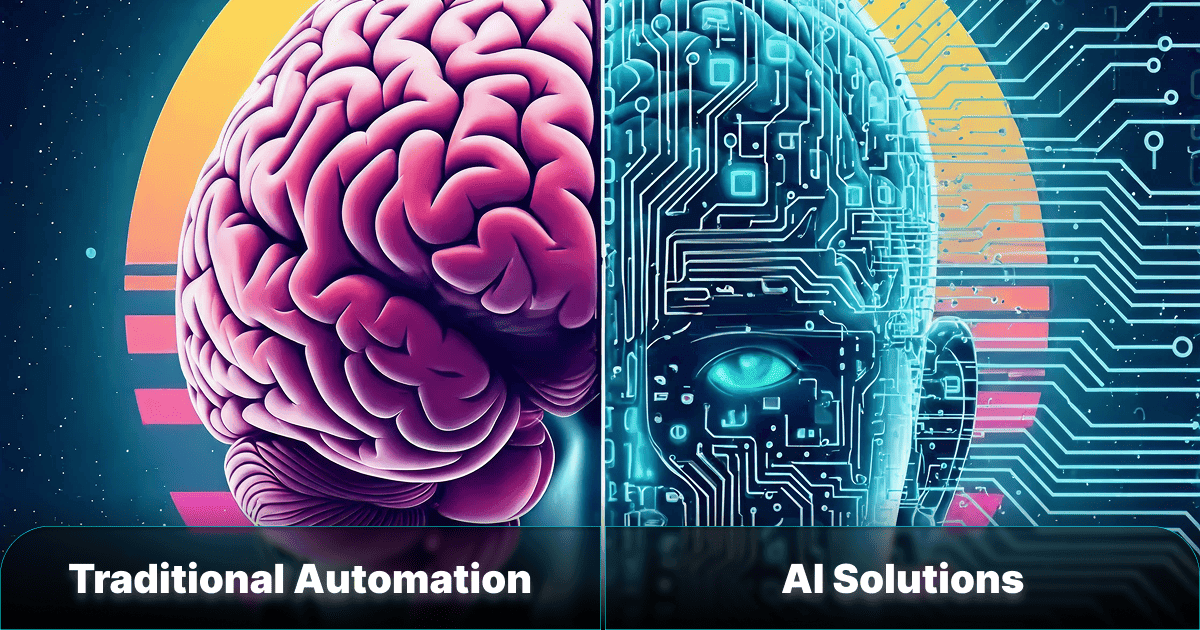
Modern industries have built scalability and efficiency with the strategic implementation of automation processes. The concept of automation mainly lies in the use of AI technology to automate repetitive tasks with little or no human intervention. Automation has been employed across diverse sectors to enhance operational efficiency in daily tasks. Think, robots can build a 10 storeys building in one month - it’s just an example to highlight the potential of AI technology to bring revolution in today’s world. In service sector, AI-powered chatbots and virtual assistants handle software billing and provide 24/7 customer assistance, ultimately enhancing proficiency and customer satisfaction
In recent years, automation processes have changed dramatically. Many companies think that they are doing “Automation”, but in reality they have just digitalized the manual work. Traditional automation processes, such as automatic invoice generation or automatic customer enquiry routing, have been turned obsolete with the jaw-dropping potential of AI solutions.
In this article, let’s walk through the key differences of Traditional Automation and AI Automation, how businesses evolve with them, and assist you identify which approach will go well with your organization.
Understanding Traditional Automation: The Challenges and Strengths
Over the years, traditional automation approaches have evolved a lot, handling diverse business operations today. Enterprises rely on these techniques to improve efficiency and consistency in their workflow. Businesses use two forms of traditional automation: Rule-based systems and Mechanical systems.
Rule based systems often follow predefined rules and instructions to operate. Such systems are widely used in software applications, where they respond to specific inputs. Invoice systems, for instance, generate similar invoices every time based on pre-set formatting and structure. These systems are often employed due to their reliability and predictability. They work well for automated repetitive tasks, however cannot make decisions on their own outside the pre-set parameters. Moreover, such systems lack adaptability in unforeseen conditions - a huge disadvantage in today’s evolving business world.
Mechanical Systems involves the use of physical machines to mimic the work of human labour. In the manufacturing sector, robotic systems and conveyor belts increase productivity by performing arduous tasks without tiring, thereby decreasing labour cost and enhancing ROI. Such systems' strengths lie in their potential to handle high volume tasks with precision and accuracy. However, rigidity is their biggest drawback. Mechanical systems require costly, time-consuming engineering work to implement alterations and processes change - unattractive features to rely on for the long term.
Unlike traditional automations, Enterprise AI solutions offer adaptability, flexibility, and enhanced business operations for existing parameters.
Key Characteristics of Traditional Automation
- Streamlined Workflows: Follows guided and predefined steps for operation.
- Structured Data: Requires proper formatting and data
- Fixed Decision-making: function based on simple yes/no framework.
- Lacks Adaptability: Process alterations require manual data handling.
Repetitive tasks often result in productivity loss. In the US, a survey showed that knowledge workers spend hours on various repetitive tasks, such as document management, copying information, and data entry. Such boring tasks drain productivity of almost 44% of employees in different organizations. Enterprise AI applications handle such kinds of data seamlessly, reducing human error and enhancing output and efficiency.
Exploring Enterprise AI Automation: A System beyond the Fixed Rules
AI tools have revolutionised the traditional automation processes that used to be impressive. Instead of operating on pre-set instructions, enterprise AI tools learn, adapt, and make data-driven decisions in unforeseen circumstances. AI solutions refers to intelligent software systems designed to mimic human intelligence in analyzing data, making decisions, and identifying unstructured patterns.
Key Characteristics of Enterprise AI Automation
- Flexible Workflows: AI automation does not follow predefined rule systems and adapt depending on the context and inputs.
- Unstructured Data: AI systems work well with disorganised data, such as incomplete information, inaccuracies, and images via natural language processes.
- Adaptability: AI-enabled systems alter outputs naturally based on user experience and improve with time from feedback and examples.
- Operational Improvement: AI tools learn and improve their responses with time without manual re-programming.
Liance legal, a law firm, was facing a challenge of manual contract clauses review across large amounts of documents in MS word. After integrating an AI assistant with MS Word to review contract clauses, they witnessed 60% fast contract drafting and 80% improvement in efficiency and quality of workforce. In the future, Enterprise AI solutions can bring more to the table than they seem to be.
Traditional Automation Vs Enterprise AI Automation: Understanding Key Differences
There is a clear difference between these two approaches and right choice can escalate the growth of your business exponentially.
Feature | Traditional Automation | Enterprise AI Automation |
|---|---|---|
Data Handling | Clean, and structured data only | Can perform well with both structured and unstructured data. |
Decision-Making | Rule-based, straightforward systems | Predictive, context-dependent and autonomous |
Learning Ability | Rigid requires manual programming for process changes | Learns from user inputs and provide mature and relevant responses over time |
Implementation Scope | Narrow and task-specific | End-to-end process abilities |
Scalability | Static based on guided system | Improves over time and works efficiently across diverse systems. |
Exception Handling | Breaks when exceptions occur. | Handles exceptions and unexpected cases. |
Maintenance | Require manual updating | Self-tuning and re-training |
Application | Spreadsheets, payroll systems, and accounting | Chatbots, predictive analytics, and fraud detection |
Transitioning from Traditional Automation to Enterprise AI Automation: Implementation Steps
If you’re still using traditional automation for your business and confused how to shift your approach to escalate the growth of your business, just follow the steps below:
- Assess your business profile: This includes the operations of your business that may involve heavy decision-making processes. AI automation works well for processes that involve judgment and analysis.
- Determine priority areas: Identify what kind of challenges you encounter frequently, such as exceptions, unstructured data, complex decision trees, or inefficient outputs. Enterprise AI solutions can resolve all of them flawlessly.
- Shift Workflow Gradually: Begin with AI-enabled systems and incorporate them with existing workflow. After careful assessment, shift workflow to full autonomous AI agents.
- Develop Data Foundation: Create systems to process outcomes and decisions. Incorporate feedback loop to assist in data training. Ensure improvement with clear quality metrics.e
- Develop Hybrid Processes: Create systems that involve AI-Human processes to distinguish between AI and human work and provide feedback systems for continuous improvement.
Enterprise AI Automation Implementation: Challenges to Overcome
- AI systems require high-quality data. Provide quality data for systems operation.
- Understand your business processes before implementation.
- Create AI Squads within the organization to fill skill gaps for AI automation.
- Complex integration may present obstacles to overcome, but AI strategy must align within the existing infrastructure.
- Management change may affect the organization’s workforce but you can overcome this challenge with proper workforce training.
Final Thoughts
The transition from the systems that work on commands to systems that evolve and understand is debatable, however when innovation is concerned AI automation is inevitable. AI technology is not about automating the processes, they bring adaptability, foresight, and insight into your business operations. Whether you are looking to optimize supply chain, enhance customer interactions, or upgrade your CRM dashboard, AI automation will position your business ahead in the pool of competitors. Just like AI - the future belongs to those organizations that evolve with changing trends.